A silver ring looks simple: a band, a stone, a price tag. Then it arrives, and it is half a size too small, the shine has dulled within a fortnight, or the setting keeps catching on your favourite jumper. Almost every silver ring regret comes down to a handful of practical details that are easy to skip when you are standing at a market stall or clicking through photos late at night.
None of it is complicated. These are the seven mistakes that come up again and again, and what to do instead.
1. Ignoring the hallmark
A hallmark is not decoration. It is the paperwork, stamped into the metal. On a genuine sterling silver ring you should find 925 or sterling, usually with a maker's mark, and on UK pieces an assay office mark as well, such as the London leopard's head, the Birmingham anchor, the Sheffield rose or the Edinburgh castle. A date letter often appears too.
In the UK, silver items above a small weight threshold must be hallmarked by an assay office before they can legally be sold as silver, so a complete absence of marks on a substantial ring is worth questioning. Very small or very light rings sometimes carry only "925", which is why it is always reasonable to ask the seller directly.
Watch for the phrases that mean there is no silver in the piece at all:
- Silver plate or silver plated — a thin layer over another metal.
- EPNS — electroplated nickel silver.
- Nickel silver or German silver — alloys that contain no silver despite the name.
2. Guessing your ring size
Fingers are not a fixed size. They swell in heat, after a salty meal, on a long flight and towards the end of the day. They shrink in cold air and first thing in the morning. Measure more than once, on different days, and if you land between two sizes, think about which direction is safer. A ring that turns slightly on the finger is easier to live with than one that leaves a red groove.
Two details catch people out. First, wide bands feel tighter, because they cover more of the finger — many people go up half a size for anything 6mm or broader. Second, your knuckle may be wider than the base of your finger. If it is, a slightly larger size or a design that slides over easily will serve you better than a snug fit.
Use a proper ring sizer or measure a ring you already wear and love. String and paper strips stretch and mislead. Sizing scales also differ between countries, so check which system the seller's chart uses before you convert anything.
3. Buying for the moment instead of your lifestyle
The ring you admire in a photograph is not always the ring your hands can carry. A tall claw setting on a nurse's, gardener's or potter's hand is a countdown to a snag. A low bezel or flush setting sits closer to the finger and takes far more punishment.
Ask yourself where the ring will spend most of its life. Typing, lifting weights, swimming, washing up, working with tools, pulling on gloves — each one favours a different design. If you plan to stack several rings, thin shanks and smooth profiles play better together than chunky ones, and a slightly larger size keeps a stack comfortable. Take rings off for swimming pools, hot tubs and cleaning, not only for the silver but for the stone and the setting.
4. Expecting sterling silver to stay pristine
Tarnish is not a fault. It is chemistry. Silver reacts with sulphur compounds in the air and with moisture, so a ring left in a bathroom cabinet will darken faster than one worn regularly and wiped with a soft cloth. Skin chemistry varies enormously, which is why the same ring can stay bright on one person and dull quickly on another.
A few habits make a real difference:
- Wear the ring often — gentle friction slows tarnish.
- Wipe it with a soft polishing cloth before storing, not after the tarnish has set.
- Keep it in an airtight bag or a lined box, away from rubber bands and wool.
- Keep it clear of bleach, hair dye and household cleaners.
Oxidised or blackened finishes are designed to fade on the high points. That is the look maturing, not the ring failing. And yes, sterling silver scratches. It is a soft metal, and a daily-wear ring will pick up fine marks. Most polish out.
5. Overlooking the setting and the shank
Look closely at the metal holding the stone. Four thin claws that are already bent will not survive a coat pocket. A bezel or flush setting holds the stone in metal rather than claws, which is a sound choice for rings worn every day.
Then look at the band. Very thin shanks bend and warp, particularly in larger sizes and on hands that grip things all day. Hollow or hollowed-out bands feel impressively light for their size and dent just as easily. If a listing gives the weight in grams and the width in millimetres, that tells you more than any styled photograph.
Think about the stone too. Softer stones such as opal, pearl, turquoise and amber need gentler treatment than a diamond or sapphire. Skip ultrasonic cleaners and harsh dips, which can damage both the stone and an antique finish.
6. Forgetting to ask about resizing and returns
Sizing is not always reversible. Plain bands within a reasonable range are usually straightforward to adjust. Rings set with stones all the way around, heavy textures, and some plated finishes cannot be resized without being remade, and an engraved ring is often non-returnable. Ask before you pay, not after.
- Can this design be resized, and how many sizes either way?
- What is the return window, and does it change for engraved or custom pieces?
- Is the metal content stated on the listing or receipt?
- What care does the seller recommend for this particular finish?
7. Letting the cheapest price make the decision
Two rings can both say 925 and feel completely different. The difference is weight, shank thickness, finishing, setting quality and how much handwork went into the piece. Very cheap silver is often very thin, or hollow, or coated with a plating that wears through at the edges within months. A low-priced set of stacking rings is perfectly good if you know that is what you are buying, and disappointing if you expected an heirloom.
Compare on weight and construction rather than on the number alone, and buy from sellers who describe the metal honestly and answer questions. For a high-value piece, a qualified jeweller or valuer can advise on whether it is worth insuring.
A five-minute check before you pay
Run through this before the money leaves your account:
- Find the hallmark, or ask the seller to confirm the metal.
- Measure your size twice, at different times of day, with a proper sizer.
- Picture the ring in your real week, not in a photograph.
- Check the setting, the shank width and the weight if it is listed.
- Confirm the resizing and returns policy in writing.
- Decide how you will clean and store it.
Silver is forgiving, affordable and beautiful when it ages well. Give it five minutes of thought at the start and you will still be wearing the ring happily in ten years.
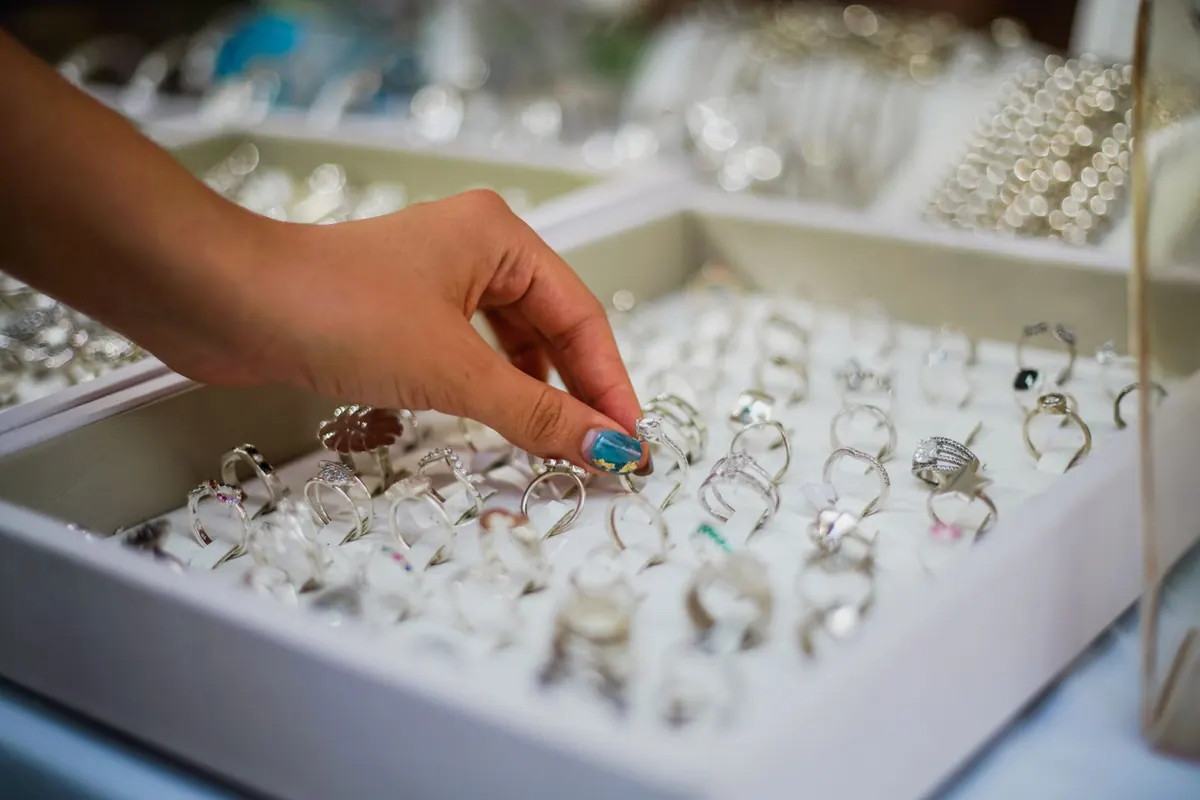
Photo: Elias Jara / Pexels