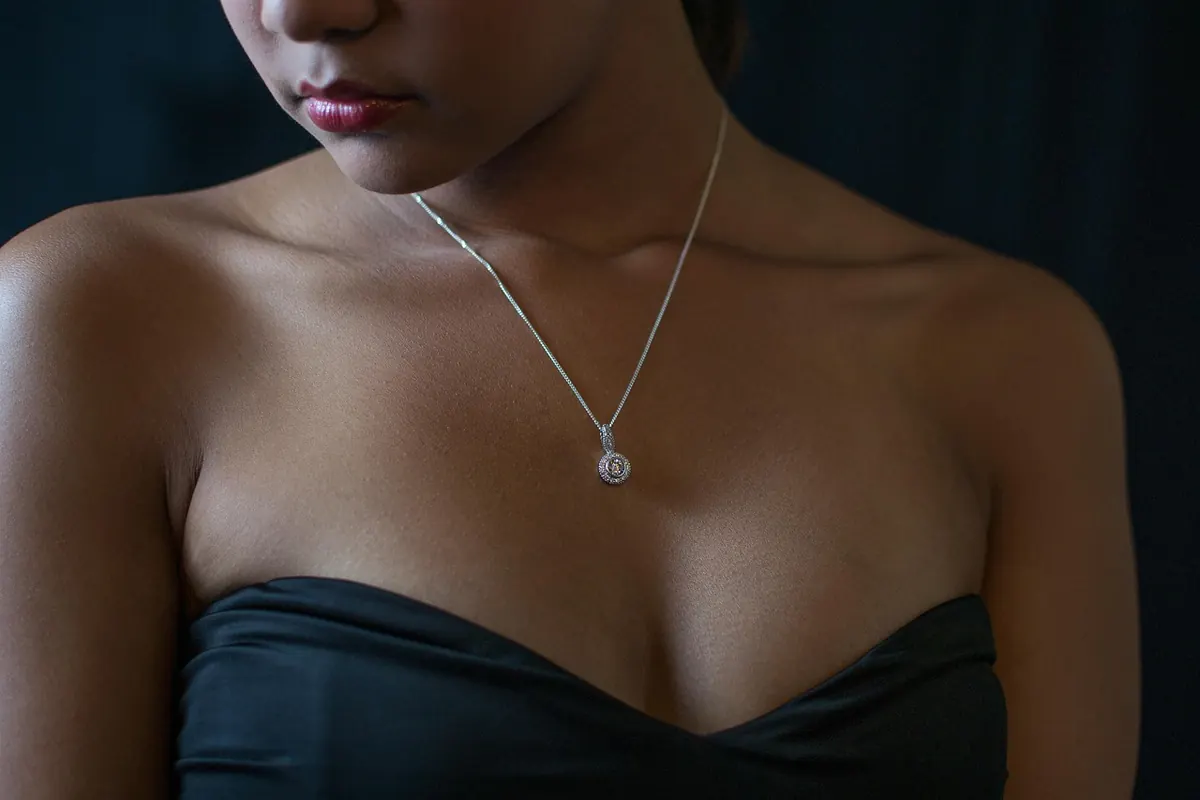
A pendant necklace is a small decision with a large effect. Two measurements do most of the work: where the chain sits on your chest, and how big the pendant reads against your frame. Get both roughly right and almost any design looks deliberate. Get them wrong and even a lovely pendant can feel like it is wearing you.
This is for the person standing in front of a mirror holding a chain at their throat, wondering whether 18 inches is right and whether the pendant is too small. Here is how to work it out in a couple of minutes.
Start With the Neckline You Wear Most
Chain length is not really about the chain. It is about the empty space it lands in.
Open necklines — V-necks, scoop necks, wrap tops, unbuttoned shirts — leave a vertical strip of skin for a pendant to fill. A chain that ends inside that space looks placed. A chain that ends right on the fabric edge looks accidental.
High or covered necklines work the other way. A crew neck, fine knit or turtleneck gives the pendant nothing to sit against except fabric, so shorter chains sit better and the pendant becomes the point of the outfit.
- Crew neck: 16–18 inches, small to medium pendant, sitting on or just below the collarbone.
- V-neck: a chain ending 2–4 cm above the point of the V, usually 18–20 inches.
- Scoop or square neck: 18 inches, centred, with a pendant that echoes the curve rather than competing with it.
- Buttoned shirt or blazer: 20–22 inches, so the pendant falls below the collar line and stays visible when you move.
- Turtleneck: 20–24 inches over the knit, or a 16-inch chain tucked at the neckline.
If you wear one neckline most of the week — a work shirt, a plain tee — buy for that one first.
A Short Chain Length Cheat Sheet
Lengths are measured in inches, and the number describes the chain laid flat and closed, not the point it reaches on your body. That point shifts with your height, neck length and posture, so treat these as starting points and check them on yourself.
- 16 inches: base of the throat, just above the collarbone. Reads as a choker on some people.
- 18 inches: the most common length. Falls just below the collarbone on most adults and suits nearly every neckline.
- 20 inches: on the collarbone or a little below. Good with shirts and heavier pendants.
- 22–24 inches: upper chest. Works over knitwear and with larger pendants.
- 30 inches and longer: the sternum or below. Usually paired with one confident pendant.
Height matters more than most guides admit. If you are tall, an 18-inch chain sits higher on your torso than it does on someone shorter, and a 20- or 22-inch chain may give the effect you were expecting. If you are petite, a 24-inch chain can land where a 30-inch chain lands on someone else.
Judging Pendant Size by Proportion
Pendant size is relative, not absolute. The same 2 cm disc looks generous on a short neck and delicate on a long one.
A workable guideline: hold the pendant in front of you at the length you plan to wear it and look at the whole picture, not just the pendant. If it covers roughly a third or less of the space between your collarbones, it will read as delicate to medium. If it covers most of that space, it becomes a focal piece and needs a simpler outfit around it.
Three things that change the answer
- Neck length: longer necks carry larger pendants comfortably. Shorter necks often look better with smaller pendants on slightly longer chains, which draws the eye downward instead of across.
- Face and frame: fine features and narrow shoulders suit finer pendants. Broader shoulders and stronger features can carry wider, heavier shapes.
- Chain weight: a bulky pendant on a hair-thin chain looks unresolved. A tiny pendant on a chunky chain looks like the chain is the pendant. Match them — delicate with delicate, substantial with substantial.
Think about weight, not just width. A dense 3 cm pendant pulls a fine cable chain into a V. If the pendant is heavy, choose a stronger chain style such as a box or curb chain, and check that the bail — the loop the chain passes through — is wide enough for the chain to slide freely.
Match the Length to the Pendant
There is a rough logic here that saves a lot of returns. Short chains and small pendants belong together, because the pendant sits near the face and acts more like jewellery than a focal point. Long chains suit larger pendants, because the eye travels further to reach them.
The awkward middle is a long chain with a very small pendant, which tends to disappear, or a short chain with an oversized pendant, which crowds the collarbone and the jaw. If you want one pendant necklace that does everything, 18 inches with a medium pendant is the safest single purchase you can make.
If you can see the pendant clearly in a mirror from two paces away without squinting or leaning in, it is holding its own.
Test It Before You Commit
You can rehearse the whole decision at home with a piece of string and a coin or button.
- Cut lengths of string to 16, 18, 20 and 22 inches, or tie knots at those marks on one long piece.
- Stand in front of a mirror in the top you wear most, in daylight if you can.
- Hold the string closed at your neck and note where each mark lands.
- Hold a coin or button at that point to approximate pendant size, and check it against your neckline.
- Turn side-on. Some lengths sit well front-on and swing oddly in profile.
- Wear the arrangement for ten minutes. Pendants that catch on collars, hair or bag straps show themselves quickly.
If you plan to layer, keep at least 2 inches of clear space between chains so the pendants do not collide, and let one piece lead. Odd numbers — one, three, five — usually look more relaxed than even ones, though that is a preference rather than a rule.
A Simple Way to Decide
Choose the neckline you wear most. Pick a chain length that ends inside that neckline's space rather than on its edge. Then hold a few pendant sizes against yourself and choose the largest one that still feels like yours. If you are between two lengths, buy the shorter one and add an extender chain — you get both options for the price of one clasp.
One practical note on metal: sterling silver is a sensible default because it is widely available and easy to care for with a soft cloth and occasional gentle polish. If you have had skin reactions to metal before, ask about the alloy before buying, keep the piece dry, and speak to a doctor if a rash appears and does not settle.
Photo: shevacreations / Pixabay